
From 1975 to 1991 |
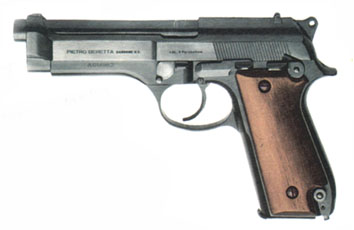
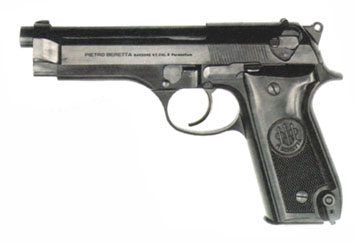
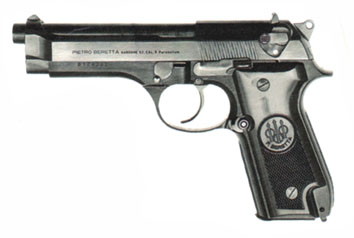
1975 After five years of study and testing, the Beretta Model 92 pistol, chambered for the 9 mm. Parabellum round (cal. 9 mm. Parabellum = 9 mm x 19 = 9 mm. NATO), was unveiled. It marked the beginning of a new generation of military pistols designed to satisfy all safety, reliability and endurance requirements of modern law enforcement and military forces.The most significant characteristics of the new design were: a light aircraft‑quality aluminium alloy frame which resulted from over 30 years of Beretta metallurgical experimentation, open slide design in the Beretta tradition, ease of disassembly and maintenance, a high capacity (15‑round) staggered magazine, and an exceptionally smooth double action coupled with a particularly strong hammer system. This combination of features, and performance characteristics insured the success of the new pistol. The superiority of the new Beretta 92 over competing pistols was soon borne out in a series of tests conducted by the Brazilian government, which adopted the Beretta Model 92 for its armed forces. 1976 Italian police forces expressed interest in adopting the new Beretta pistol. For reasons of training and operational safety, the Italian police requested a modified version of the 92, incorporating a hammer drop safety mechanism which rotates the firing pin away from the hammer's action. 1977 This version of the 92, renamed the Model 92S, was adopted by the Italian state police and subsequently by the Italian Carabinieri. These new Beretta pistols replaced the Model 34 cal. 9 mm. short and Model 51 cal. 9 mm. Parabellum pistols being used by these corps. 1978 The U.S. Government's Joint Service Small Arms Pro gram QSSAP) requested the United States Air Force to conduct a series of comparative tests of standard 9 mm. Parabellum pistols produced by leading pistol manufacturers worldwide.The objective of the test was to select a 9 mm. replacement weapon for the aging Colt 1911 Al .45 cal. pistol. 1979 Beretta submitted its Model 92S‑1 (a 92S with reversible magazine release in the trigger guard, ambidextrous safety lever, grooved frame to improve the grip, and larger sights) to the U.S. Air Force for testing. 1980 While
these American tests were being carried
out, Beretta made use of valuable operational
experience gained by working with other
police and military forces to develop a
new prototype pistol with an additional
safety feature: the automatic firing pin
block. The new firing pin block system constantly
engages the firing pin to prevent an accidental
discharge. The firing pin block system can
only be released by pulling the trigger
all the way back. Thus, the Beretta 92SB
was born with new feature added to the improvements
already made in the 92S‑1. At the
end of 1980, the official results of the
American testing program were announced.
The Beretta 92S‑1 was judged best
by a large margin over numerous other 9
mm. models. These included the Colt SSP
(stainless steel), Smith & Wesson 459,
FN DA, FN FA, FN High Power, Star M28, Heckler
& Koch P 95 and VP 70.
1981 The new Beretta 92SB replaced the earlier 92S version in the deliveries to police forces and Carabinieri. In the meantime, many state police forces in the United States, stimulated by the extraordinary results of the American Military tests, made the decision to adopt the Beretta 92SB pistol. A new compact version of the 92SB featuring reduced length, height and weight was developed and designated the Model 92SB Compact This slightly smaller version of the successful Model 92SB was also chambered for 9 mm Parabellum. The Beretta Model 98, chambered in 7.65 mm Parabellum, was also made available for sporting use. As the long‑waited results of the exhaustive U.S. Air Force pistol test were announced and officially accepted by JSSAP, the U.S. Army criticized the validity of the testing procedure, insisting that the Air Force used the wrong type of "mud" and committed other errors which resulted in a favourable recommendation of the Beretta pistol. As a result the Department of Defence (DOD) requested that the U.S. Army carry out a new series of tests following an extremely rigid test program. These tests were so severe that at the end of the competition, all weapons tested were rejected. Even under these conditions, the Beretta pistol was again proven to be the best of the group. The Connecticut State Police adopted the Beretta 92SB in 1981, 4 years before the US Army. No other major US city or State police force adopted the Beretta before the US Army did so. 1982 In
May of 1982, a new testing procedure was
establish ed for the U.S. Military test.
This procedure used revised reliability
criteria approaching more realistic levels,
but still did not allow any pistol to
qualify and no tests were conducted. Product
development in Gardone Val Trompia continued
during this period, yielding yet another
new variation of the 92SB: the 92SB Compact
"Type M". The new compact type
M pistol, also chambered for 9mm Parabellum,
featured an 8‑round single line
magazine with reduced grip width. A corresponding
7.65 mm. Parabellum version designated
the Model 99, was developed for the commercial
market.
1983 As
a result of pressure exerted by U.S. Congress,
new tests were requested in the United
States, and the U.S. Army was again chosen
by JSSAP to carry out these tests designated:
XM9 Service Pistol Trials (SPT).
In Italy, work continued on yet another
new version of the Model 92S13. Designated
the Model 92F (initially referred to as
the 92SB‑F), it was given a combat
trigger guard to improve the grip during
two‑handed shooting, the barrel
was internally chromed, and a matte black
“Bruniton”®
finish is added. In fact, this
model was identical to the previous Model
92SB with certain modifications to make
it even more competitive in the U.S. Military
tests.
1984 The new XM9 tests started at the beginning of the year and included seven candidates: Smith & Wesson 459A, Beretta 92SB‑F, SIG Sauer P‑226, Heckler & Koch P7, Walther P88, Steyr GB and F, and the Browning ADA. The tests were conducted in different locations that specialized in various types of tests (adverse conditions, ballistics, endurance, targeting and accuracy, and reliability testing). The testing took until September to complete. Announcement of the winner of the competition was delayed due to legal opposition of two of the competing manufacturers: Smith & Wesson and Heckler & Koch, whose pistols were disqualified in the initial phase of the testing. 1985 On January 14, the U.S. Army officially announced that the Beretta 92SB‑F was the clear winner of the competition. The Beretta pistol, designated by the U.S. Military as the M9, was one of only two weapons that successfully completed the test. The other finalist was the Swiss‑German SIG Sauer P226. The contract for 315,930 pistols valued at approximately $ 75 million was awarded to Beretta U.S.A. Corp., Pietro Beretta's U.S. affiliate, on April 10, 1985. Smith & Wesson of Springfield, Massachusetts, initiated legal action aimed at interrupting the acquisition of the M9 pistol by the U.S. Military. In accordance with the terms of the contract, while Beretta U.S.A. Corp. proceeded to tool up for local production of M9 pistols, P. Beretta Gardone V.T. began to manufacture the M9 pistol. In the course of the year, production of the 92F began for the commercial and Military markets, as was the 9mm X21 IMI, designated Model 98F, which was destined for the Italian market only. The French Minister of Defence, André Giraud, authorized a competition on behalf of the National Gendarmerie, which led to the purchase of 110,000 9mm Parabellum pistols as replacements for the MAC 50 pistol. These pistols would be produced in France by a French company. Beretta 1988 During
this period, work was proceeding
to develop the 92F in stainless
steel, and new target versions
were being unveiled. The 98F Target,
cal. .9mm X21 IMI, for large caliber
shooters, and the competition
conversion kit for the 92K In
the United States, Beretta U.S.A.
in Accokeek, Maryland, began production
of the M9 pistol. Smith &
Wesson succeeded in delaying a
second contract award for a continuation
of the initial M9 contract by
convincing the U.S. Congress to
order yet another new competition,
called the XM10, to take place
in the spring of 1988. The Sturm
Ruger P85 and the Tanfoglio C75
participated in this competition,
but were soon disqualified. Beretta
and SIG Sauer, finalists in the
XM9 competition, were not requested
to submit samples to the new test
Surprisingly, Smith & Wesson
did not participate, claiming
that if the Beretta M9 should
not be retested, neither should
Smith & Wesson. Smith &
Wesson's protests of Beretta and
SIG Sauer exemption from the XM10
competition resulted in a second
XMIO competition which started
in September, 1988.
1989 Sturm Ruger and Smith & Wesson participated in the second XM10 Competition. Determined to remove any doubt about the Beretta pistols, the U.S. Army selected 30 M9 pistols at random from a recent shipment received from Beretta U.S.A. and submitted them for testing. Again, as in the preceding competitions, the Beretta 92F was the winner and a new contract was awarded bat the U.S. Army on May 22, 1989, for approximately 57,000 M9 pistols with a value of approximately $ 9.9 million U.S. dollars. The award of this contract may lead to other successive contracts to complete the comprehensive requirements of the DOD (approximately 500,000 pistols for the Army, Navy, Air Force, Marines and Coast Guard). Beretta decided to make production of the 92F uniform by adding to all 92F pistols the modifications ordered by the U.S. Army. The new version was called the 92FS. 1990 In order to satisfy increasing demand from American police forces that had decided to replace the revolver with high capacity automatic pistols, Beretta U.S.A. introduced new special versions of the 92 for law enforcement. These included the 92C (the CI of the French National Gendarmerie), the 921), double action only without manual safety, and the 92DS, double action only with manual safety. 1991 Under
development and test in Gardone
V.T. is a new version of the 92
pistol (Model 96), chambered for
the new .40 S&W cal. Beretta
U.S.A. has received numerous letters
of appreciation from American
Military personnel who took part
in Operation Desert Shield and
Operation Desert Storm regarding
their official sidearm, the Beretta
M9. The following excerpts are
typical of the letters we have
received: «...
I just want to commend you on
the fabulous model 92F. I have
had mine for about a year now
adjust love it. It feels like
that pistol was made especially
for me. The design Is so smooth
and comfortable, it seems like
an integral part of my body. I
just can’t shot it enough. Uncle
Sam made an excellent choice in
the Beretta M‑9. Well, I just though that I would drop you a line to let
you know what a great weapon you
have given us. Keep up the great
work!»
|
|
|
| |
|