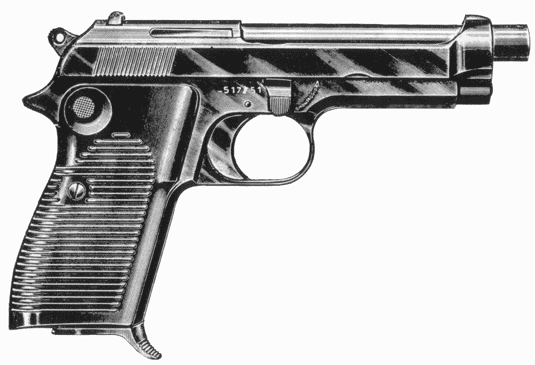
The first Beretta releable pistol made in 9 parabellum
The
definite adoption of the 9 mm calibre " para. bellum "
for the automatic pistols issued to the Armed Forces and Police
detachments during the last war, was not only caused by the necessity
to unify the calibres of pistols and light machine guns (especially
Sten gun type), of ever increasing diffusion with the Armed Forces
of the various countries, but also by the excellent ballistic
characteristics of this calibre.
The
difficulties in supply and adequate training as well as the serious
inconveniencies produced in the logistical sector of operating
units, and caused by the existing differences in calibre of the
small arms, are well known. |
 |
This
need for the unification of the small arms calibres was felt most
strongly by the Navy and Air-Craft Forces it their special detachments
often engaged in isolated raids, landing operations, command actions,
police service, etc. And the considerable supply difficulties
aggravated by the special displacements of these units (such as
bridgeheads, ports, observation points, airports, etc.) made it
necessary to reduce the types of ammunition to be issued to each
group to the absolute minimum.
To
satisfy above-mentioned requirements the " Pietro Beretta
" Weapon Factory decided to study and to realise a "
9 mm. long " calibre automate pistol, answering to the above
characteristics, and which does represent not only the experiences
gained by its staff in the manufacture of over 2 million pistols,
but also the results of the studies and experiences of the best
foreign industries. |
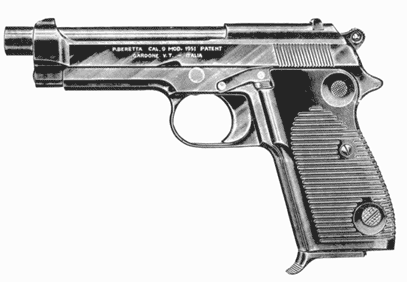 |
This
pistol uses as locking device a vertically sliding, catch, the
recharging system is based upon the recoil of the barrel; both
operations have already been proved with excellent results by
the construction technique here and in the best foreign industries.
The system
presents, in addition, and compared with that based upon fixed
barrel and single gas utilisation, with equal cartridge and weight,
the considerable advantage of a sensible reduction of the recoil
speed with the consequent reduction in the jumping of the weapon
during the firing. Outstanding are the excellent results obtained
through the use of the light alloy "Ergal" in the manufacture
of the body, which made possible the reduction of the weight of
the 9 mm long to an only 0,720 kg. (25.4 ozs), using at the same
time the ammunition of the light machine gun which is considerable
more powerful than the normal 9 mm. long ammunition as used before
the war. |
 |
|
System Operation
Recoil barrel locked by a vertically sliding catch
Magazines
Standard magazine charge: 8 rounds
Special magazine charge: 10 rounds (a further round may be placed into the chamber)
Weight of the weapon with magazine:
Steel (frame) body: 890 g. (31.4 ozs)
Ergal (frame) body: 720 g. (25.4 ozs)
Cartridge: 9x19mm Parafor pistols and machine pistols «(parabellum ») or sub - machine guns
Maximum recoil speed of bolt approx. 7,5 m/sec (24.6 ft/sec')
Weight of cartridge: 7,45 g. (0.25 ozs)
Weight of charge: 0,39 g. (6 grains)
Initial speed V 10: approx. 340 m/sec (1164 ft/sec)
Maximum gas pressure: 2100 kg/CM2 (29,862 lbs/ sq. in.)
|
 |
Operactions
Grip the pistol with the right hand and with the left introduce
the magazine pushing it well into the chamber until it is locked
by the catch. Grip the bolt by the checkered part pulling it back
with a quick move, then let it snap forward (this operation will
be accelerated by previously lowering the hammer). The weapon is
now loaded and ready to be fired.
Pulling now the trigger the trigger lever is pushed back against
the hammer catch and throws it over, liberating thus the hammer
which, in turn, is pushed forward by its compressed spring hitting
the percussion pin and firing the weapon.
The firing mechanism of this weapon differs from previous Beretta
models in that it presents a very high sensibility without, however,
the danger of any untimely firing. This model. like the other models,
possesses a hammer controlled by two catches, of which the first
one, the safety catch, stops the hammer in case of insufficient
lifting, preventing thus that it hits the percussion pin.
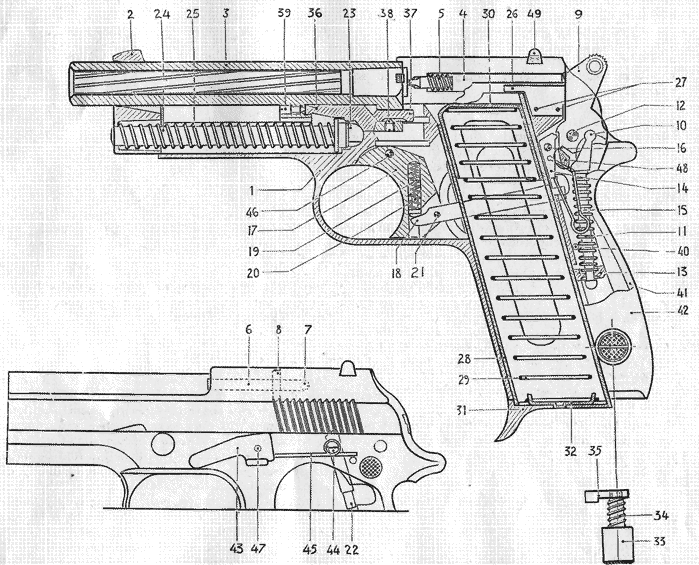
After the
firing of a round the expanding gases act against the cartridge
case pushing it and the bolt together with the barrel, tightly
locked to it, backwards. After a backward movement of about 7
mm. (1/4 inch) pin (37) provided in the rear end of the barrel
hits against an angle of the body and, acting with its front end
against the inclined recess at the lower part of the locking catch,
forces the latter to turn downwards, and to introduce its lateral
guides into the slots provided on the bolt. The backward movement
of the barrel is stopped, while the bolt continues its recoil
effecting at the same time the extraction and ejection of the
empty case.
The duration
of the recoil of the barrel-bolt group has been studied in such
a way that, at the moment of the disconnection of the locking
catch, the bullet ha already left the mouth of the pistol and
the gases have been completely dispersed. The recoil spring is
compressed by the backward movement of the bolt, at the same time,
the hammer is turned back and grips the sear lever so that the
weapon is again ready.
Completed
the recoil, the recoil spring carries the bolt again forwards.
During this move the bolt grips a round from the magazine and
introduces it into the chamber, carrying at the same time the
barrel forward to its original position while the locking catch,
forced by the inclined recess at the lower side, which slides
on a corresponding inclined surface, is turned upwards introducing
its guides into the respective slots provided on the bolt. The
trigger lever, during the recoil of the bolt, has been forced
down by the disconnecting lever (22) (controlled by the ribs of
the bolt), and is thus disengaged from the sear lever which returns
into its original position. Thus a continuous uncontrolled firing
of the weapon is made impossible even if the pressure is kept
by mistake upon the trigger. Leaving the trigger free, its lever
is lifted and reengage the sear lever pivot, the weapon is again
ready to be fired. Renewing successively the pressure upon the
trigger, the above described operations will repeat themselves
and the weapon will fire until the magazine is emptied. |
 |
Empty
magazine:
As soon as the last round is fired and its case ejected, the magazine
feeder will lift the bolt stopping catch and fix the bolt in the
recoil position; the weapon will thus remain open and the inconvenience,
found with other pistols, that the feeder of the empty magazine
becomes blocked between body and bolt, with the subsequent difficulty
of the extraction of the magazine case, is prevented. To reload
the weapon pull out the empty magazine case, insert a full magazine
and push the checkered button of bolt stopping lever downwards;
the latter, sliding down, will disengage the bolt which slides again
forwards, introducing at the same time a new round from the magazine
into the chamber of the barrel. The weapon is ready to be fired.
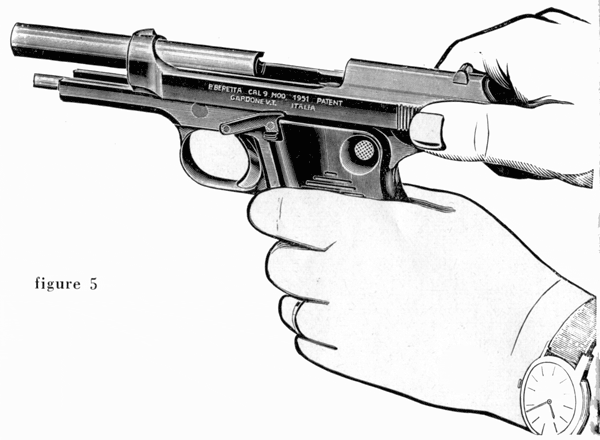
This return of the bolt into forward position could also be effected
by "ripping the chekered part of the bolt and drawing it back.
The lever, pushed by its spring, will slide down and disengage the
bolt. (see figure 5).
Round
in barrel:
With a round in the barrel the end of the extractor remains slightly
lifted and covers a red-marked sign; the position can also be
felt by touch only.
Safety catch
:
The safety catch has been designed to function only with loaded
hammer, it blocks at the same time the hammer and the sear lever.
Pushing the button of the catch from right to left the catch will
engage the two devices, pushing from the left to the right, they
will be disengaged at the same moment. This device has been studied
to allow maximum speed to obtain the firing position, i. e., by
simply pushing the button with the thumb of the hand holding the
weapon. The location of the button is such that, an involuntary
passage from the safe to the firing position is practically impossible.
With the weapon not in ready position the safety catch need not
be engaged as the percussion pin is completely blocked and kept
in this position by its spring without extruding into -the breech:
with a round in the barrel the weapon could not fire even if the
hammer should be pulled by accident. |
|
Stoppages
The most important stoppages which may occur are: misfire - incomplete locking - missed feeding - blocked cartridge case - blocked round.
Misfire
This trouble can be caused by deformation or rupture of the percussion pin, by a weak hammer spring, defects of the round, by dried oil, dirt, or other material blocking the free sliding of the percussion pin, by incomplete locking caused by a weak recoil spring or dried oil and dirt in the grooves of the bolt. Recharge hammer and repeat the firing. Should the stoppage re-occur, eject cartridge from the barrel by pulling the bolt back. 1f the stoppage continues, control the parts indicated above and substitute those which are damaged, used, or broken.
Incomplete locking
Incomplete locking can he caused by weakness or rupture of the recoil spring, or by dried oil and dirt in the grooves of the bolt guides, on the surfaces of the locking catch slide planes, or in other devices controllin-, the funetioning of the various parts.
Unload weapon, cheek spring and change if required: if necessary, clean the weapon with special attention to the grooves and planes.
Missed feeding
Missed feeding is caused by a weak feeder spring, damaged magazine case, or faulty functioning of the magazine locking catch.- check and replace as required the faulty parts.
|
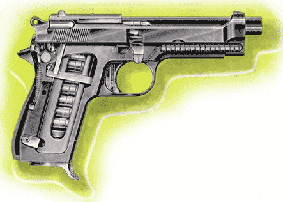 |
Blocked - cartridge case
The cartridge case can be blocked by faulty functioning of the ejector or extractor or the respective spring; by incomplete recoil of the bolt due to foreign matter in the sliding grooves: take out the magazine, pull the bolt back and shake the case out, cheek ejector and spring and change if faulty; at the same time clean the grooves.
Blocked round
Take out the blocked round; if the stoppage repeats cheek the functioning of the feeder spring, the lips of the magazine for possible damage; change whatever parts may be damaged. Control also the magazine locking each. |
 Owner Manual Owner Manual |
|
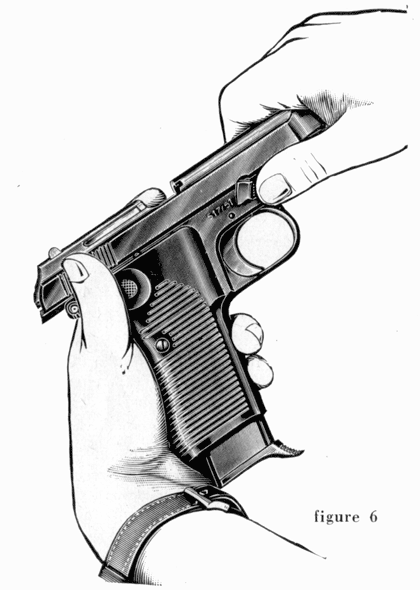
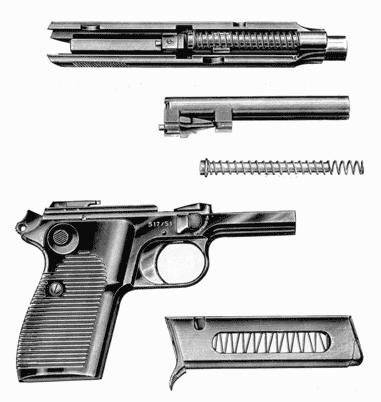
Disassembling
of the weapon is carried out as follows:
1) make sure
that the weapon is unloaded by observing the position of the extractor
end;
2) pull the hammer
3) pull the magazine out
4) grip the pistol with the left hand and, with the left hand,
push the bolt back until the recess cut into the right side of
the bolt corresponds to the position of the disassembling catch
(figure 6);
5) stop the bolt with the fore-finger of the left hand in this
position to allow the turning of the checkered button of the disassembling
catch;
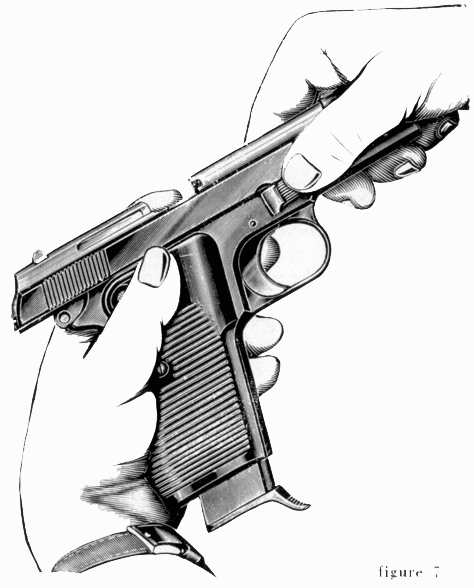
6) turn the button by a quarter turn in direction of the arrow
etched into the body (see figure 7).
|
|
|
7) Barrel
and bolt are now disengaged and can be easily slid off the body.
To disengage the bolt from the barrel, take out
the recoil spring and press the button which operates the locking
catch. The barrel will then easily slide off the guides. For reassembly
repeat the same operations starting with the last; rotating first
the checkered assembling catch button into the position shown on
figure 7). |
| Variants |
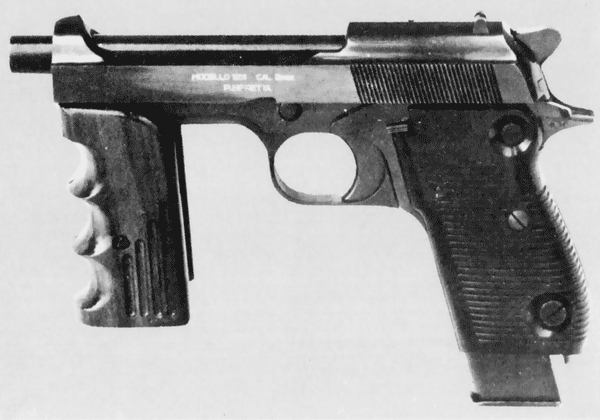 |
Model
1951R
Selective
fire version of the Mod.51. Heavier and longer, it has a folding
vertical fore grip and a selector switch mounted on the right
of the receiver.
|
| |
|
|
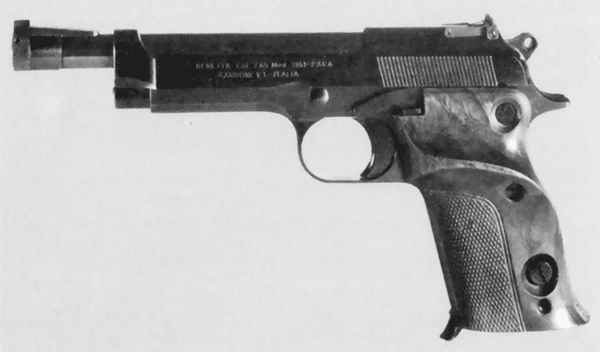
Model
1951 Special
Target
shooting version of the Mod.51, made according to suggestions
proposed by Colonel Berhama of the Egyptian army. |
| |
|
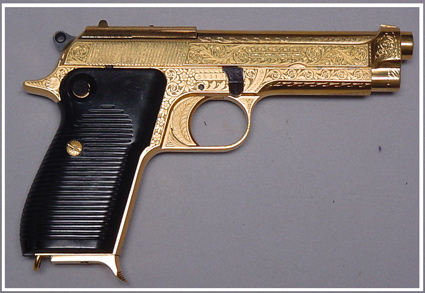 |
Model
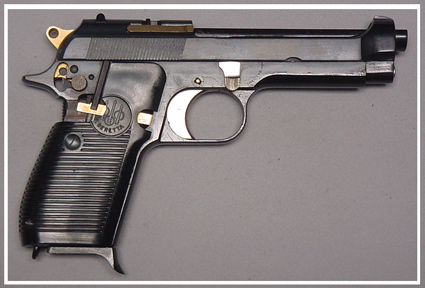
51 DeLuxe "Gold Plated" |
| |
|
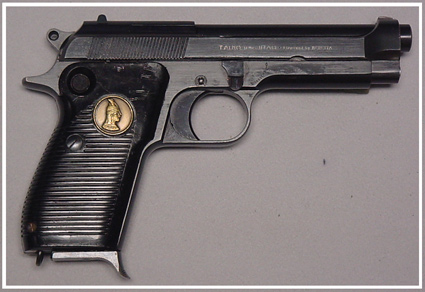 |
Model
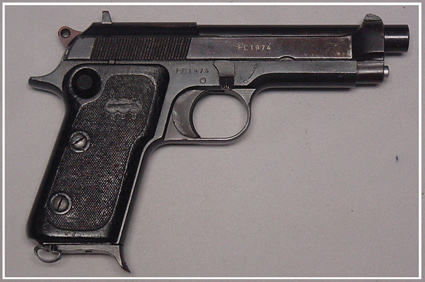
51 Made in Iraq (licencesed by Beretta) |
| |
|
 |
Model
51 Made
for Egypt Army since the 1955 and produced in Egipt after 1957 (licencesed by Beretta) |
| |
|
 |
Mod.
51 Factory Cutaway |
|
|