

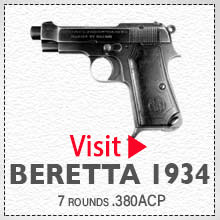
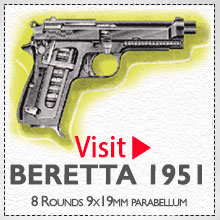
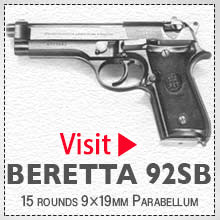
From 1975 to 1981 | From 1982 to 1987 | From 1988 to 1991 |
1975 After five years of study and testing, the Beretta Model 92 pistol, chambered for the 9 mm. Parabellum round (cal. 9 mm. Parabellum = 9 mm x 19 = 9 mm. NATO), was unveiled. It marked the beginning of a new generation of military pistols designed to satisfy all safety, reliability and endurance requirements of modern law enforcement and military forces.The most significant characteristics of the new design were: a light aircraft‑quality aluminium alloy frame which resulted from over 30 years of Beretta metallurgical experimentation, open slide design in the Beretta tradition, ease of disassembly and maintenance, a high capacity (15‑round) staggered magazine, and an exceptionally smooth double action coupled with a particularly strong hammer system. This combination of features, and performance characteristics insured the success of the new pistol. The superiority of the new Beretta 92 over competing pistols was soon borne out in a series of tests conducted by the Brazilian government, which adopted the Beretta Model 92 for its armed forces. 1976 Italian police forces expressed interest in adopting the new Beretta pistol. For reasons of training and operational safety, the Italian police requested a modified version of the 92, incorporating a hammer drop safety mechanism which rotates the firing pin away from the hammer's action. 1977 This version of the 92, renamed the Model 92S, was adopted by the Italian state police and subsequently by the Italian Carabinieri. These new Beretta pistols replaced the Model 34 cal. 9 mm. short and Model 51 cal. 9 mm. Parabellum pistols being used by these corps. 1978 The U.S. Government's Joint Service Small Arms Pro gram QSSAP) requested the United States Air Force to conduct a series of comparative tests of standard 9 mm. Parabellum pistols produced by leading pistol manufacturers worldwide.The objective of the test was to select a 9 mm. replacement weapon for the aging Colt 1911 Al .45 cal. pistol. 1979 Beretta submitted its Model 92S‑1 (a 92S with reversible magazine release in the trigger guard, ambidextrous safety lever, grooved frame to improve the grip, and larger sights) to the U.S. Air Force for testing. 1980 While
these American tests were being carried
out, Beretta made use of valuable operational
experience gained by working with other
police and military forces to develop a
new prototype pistol with an additional
safety feature: the automatic firing pin
block. The new firing pin block system constantly
engages the firing pin to prevent an accidental
discharge. The firing pin block system can
only be released by pulling the trigger
all the way back. Thus, the Beretta 92SB
was born with new feature added to the improvements
already made in the 92S‑1. At the
end of 1980, the official results of the
American testing program were announced.
The Beretta 92S‑1 was judged best
by a large margin over numerous other 9
mm. models. These included the Colt SSP
(stainless steel), Smith & Wesson 459,
FN DA, FN FA, FN High Power, Star M28, Heckler
& Koch P 95 and VP 70.
1981 The
new Beretta 92SB replaced the earlier 92S
version in the deliveries to police forces
and Carabinieri. In the meantime, many state
police forces in the United States, stimulated
by the extraordinary results of the American
Military tests, made the decision to adopt
the Beretta 92SB pistol. A new compact version
of the 92SB featuring reduced length, height
and weight was developed and designated
the Model 92SB Compact This slightly smaller
version of the successful Model 92SB was
also chambered for 9 mm Parabellum. The
Beretta Model 98, chambered in 7.65 mm Parabellum,
was also made available for sporting use. As the long‑waited
results of the exhaustive U.S. Air Force
pistol test were announced and officially
accepted by JSSAP, the U.S. Army criticized
the validity of the testing procedure, insisting
that the Air Force used the wrong type of
"mud" and committed other errors
which resulted in a favourable recommendation
of the Beretta pistol. As a result the Department
of Defence (DOD) requested that the U.S.
Army carry out a new series of tests following
an extremely rigid test program. These tests
were so severe that at the end of the competition,
all weapons tested were rejected. Even under
these conditions, the Beretta pistol was
again proven to be the best of the group. The Connecticut State Police adopted
the Beretta 92SB in 1981, 4 years before
the US Army. No other major US city or State
police force adopted the Beretta before
the US Army did so. |
|
|
|
|
Mod. 92S1 |